



Latest News from the World of Breathalyzers

AlcoSense gives input to Government Road Safety Strategy Consultation
AlcoSense has submitted a detailed response to the Government’s consultation on a new Road Safety Strategy, calling for tougher action to reduce drink-drive deaths and injuries in England and Wales.
The submission argues that England and Wales are now out of step with the rest of Europe in retaining the current drink-drive limit of 80mg of alcohol per 100ml of blood - the highest legal limit anywhere in Europe.
A central recommendation is that the legal alcohol limit should be reduced. AlcoSense argues that the current limit can create a misleading impression that driving below 80mg is “safe”, despite extensive evidence showing impairment begins well before that level.
The response highlights international research showing that crash risk rises significantly even at relatively low blood alcohol concentrations. It also notes that Scotland reduced its limit to 50mg in 2014, bringing it into line with most European countries.
AlcoSense believes lowering the limit would:
- send a clearer public safety message
- encourage more people to avoid alcohol entirely when driving
- help shift social attitudes around drink driving
- reduce deaths and serious injuries over time
The response also calls for stronger enforcement measures.
These include:
- introducing random breath testing powers for police
- allowing roadside licence suspension for drivers who fail or refuse a breath test
- tougher penalties for serious drink and drug driving offences
- wider use of alcohol interlock devices (“alcolocks”) as part of rehabilitation programmes
The submission argues that deterrence depends not only on legal limits, but also on the perceived likelihood of being caught.
AlcoSense’s response references new polling commissioned by the company which suggests strong public backing for reform.
The survey of 2,000 UK adults found:
- only 12% believe the current 80mg limit should remain unchanged
- 78% support some form of reduction
- 75% support roadside licence suspensions for motorists over the limit
- 70% support random breath testing
- 73% support vehicle seizure powers for drink and drug driving offences
The findings suggest many people now view drink driving primarily as a public safety issue rather than simply a motoring offence.
The response notes that although drink-drive deaths are far lower than in previous decades, progress has slowed in recent years.
Department for Transport figures show there were 260 fatalities in drink-drive collisions in 2023, alongside more than 6,000 injuries.
AlcoSense argues that the current approach may have reached the limits of its effectiveness and that a combination of lower limits, visible enforcement and public education is now required to achieve further reductions in casualties.
A PDF copy of AlcoSense’s full response to the Government consultation can be downloaded here: AlcoSense Laboratories - Drink Drive limit Consultation response.pdf
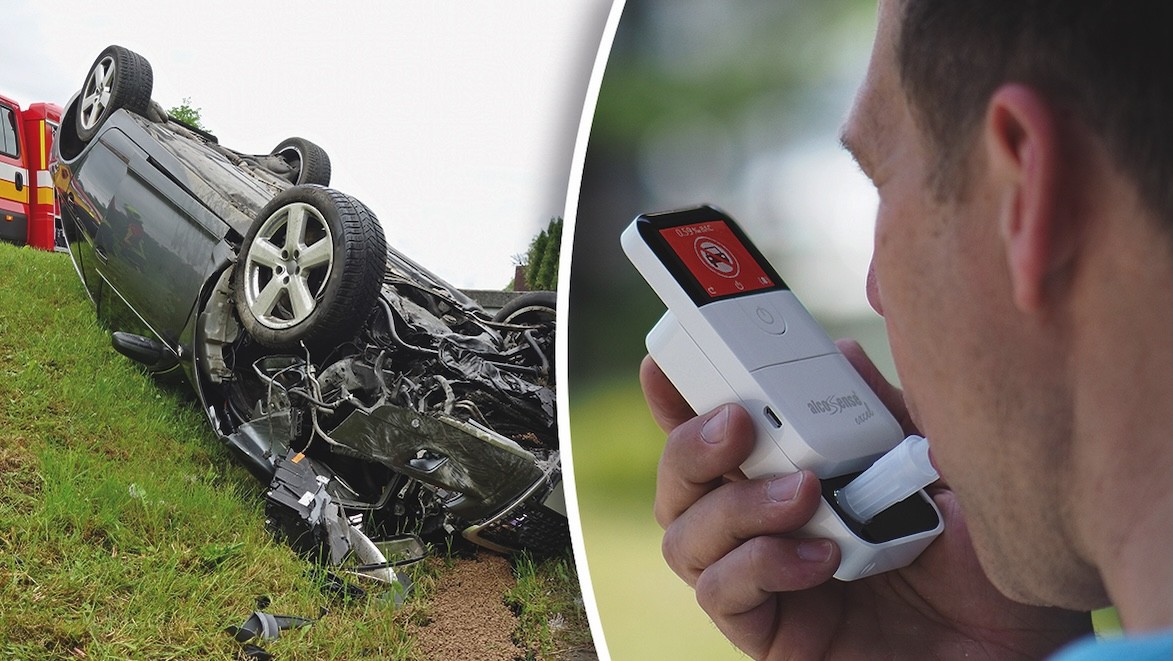
A new survey of 2,000 UK adults shows nearly eight in ten respondents (78%) said the current legal alcohol limit should be lowered from 80mg of alcohol per 100ml of blood. Just 12% said it should remain unchanged.
87% believe stricter penalties are needed to deter people from driving under the influence.
The poll by personal breathalyser firm AlcoSense is an early indication of public sentiment, ahead of the Government’s Road Safety Strategy consultation deadline of 11 May.
Nearly eight in ten respondents (78%) said the current legal alcohol limit should be lowered from 80mg of alcohol per 100ml of blood. Just 12% said it should remain unchanged.
Half of those surveyed (50%) said the limit should be slashed to 20mg or zero. A further 28% said it should be brought into line with Scotland’s 50mg limit.
There is also a clear consensus for more immediate enforcement powers. Three quarters of respondents said police should be able to suspend a driver’s licence at the roadside if they test over the limit or refuse to provide a sample.
AlcoSense managing director Hunter Abbott said the findings, which included questions similar to those in the Government consultation, indicated a shift in public attitudes.
“People are saying the current system is not tough enough,” he said. “There is staunch support not only for lowering the alcohol limit, but also for giving police the powers they need to deal with offenders quickly and effectively.
“England and Wales currently have the highest drink-drive limit in Europe. Our research suggests that many people no longer see that as acceptable.”
The call for stricter limits is even greater for higher-risk groups. Around two-thirds of respondents said commercial and novice drivers should be subject to a 20mg or zero limit.
The study suggests the public sees legal limits and police action as equally important. A majority (58%) said the most effective way to tackle drink driving would be to combine a lower limit with more robust enforcement, rather than relying on either approach alone.
“There is a clear recognition that changing the law on its own is not enough,” said Abbott, who is also a member of PACTS.
“People want to see enforcement alongside it, so that the rules have real impact.
“Motorists who pose a risk should not be allowed to continue driving while legal proceedings are ongoing,”
The latest data published by the Department for Transport show there were 260 fatalities in drink-drive accidents in 2023, with a total of 6,310 people injured in incidents involving drivers over the legal limit.
The survey findings also indicate that more stringent drink-drive laws will have limited impact on social behaviour. More than a third of those who visit pubs and restaurants said their habits would not change if the limit was reduced, while only a small minority (13%) said they would be likely to visit licensed premises less often.
Abbott added: “With the consultation closing soon, this indicates that the public expects meaningful Government action to improve road safety and prevent avoidable deaths and injuries.”
-ends-
23 April 2026
Notes:
PACTS is the Parliamentary Advisory Council for Transport Safety
AlcoSense interviewed 2,000 nationally representative UK adults via OnePoll between 24-27 March 2026. OnePoll adheres to the MRS Code of Conduct.
» read more
More than 2,700 drink-driving offences were recorded in Northern Ireland in the past year, prompting fresh warnings to motorists ahead of St Patrick’s Day celebrations.
Road safety campaigners say drivers should be particularly wary of the “morning after” effect, when alcohol from the night before can still leave them over the legal limit.
Official figures show there were 2,763 drink-driving offences recorded in Northern Ireland in the 12 months to November, highlighting that alcohol remains a significant factor in road safety incidents.
During the PSNI’s recent Christmas drink-drive enforcement campaign, officers carried out around 5,200 roadside breath tests, with more than 7% of motorists either failing the test or refusing to provide a sample.
In total, 288 people were arrested - with Belfast City once again recording the highest number of drink-drive arrests (56).
“Many people assume that if they’ve had a good night’s sleep they will automatically be safe to drive the next morning, but that’s simply not the case,” said Hunter Abbott, Managing Director of breathalyser firm AlcoSense.
“Alcohol is processed slowly by the body. Even if you feel fine the next day, you could still be over the legal limit and impaired.”
Research shows that at the legal drink-drive limit in Northern Ireland, a driver is around 13 times more likely to be involved in a fatal collision than when completely sober.
AlcoSense is urging people celebrating St Patrick’s Day to plan ahead. Options include arranging a lift home, taking a taxi or public transport, or choosing a designated driver who will not drink.
“If you’re unsure whether you’re safe to drive the next morning, the only way to know for certain is to use a personal breathalyser,” added Abbott.
“St Patrick’s Day should be about celebrating with friends and family. No one wants those celebrations to end in tragedy.”
Drivers caught over the limit in Northern Ireland can face up to six months in prison, a fine of up to £5,000 and a driving ban of at least 12 months.
» read more
Forbes tests AlcoSense Ultra: what the UK’s proposed lower drink‑drive limit means for drivers
Read Forbes' review of the AlcoSense Ultra here: https://www.forbes.com/sites/trinityfrancis/2026/0...
The UK Government has announced a consultation on lowering the drink‑drive limit in England and Wales, aiming to align it more closely with Scotland’s stricter threshold. If adopted, that would make precision even more important when deciding whether to drive — especially the morning after. [4]
In a recent article, Forbes explored this exact question. To understand how real‑life drinking translates into legality, the author used the AlcoSense Ultra across common scenarios. The takeaway was clear: with lower limits, what might feel “fine” can still put you over — and only an accurate reading tells you where you stand. [1]
The law today — and what could change
Right now, the legal limit is 35 micrograms per 100 ml of breath in England, Wales and Northern Ireland, while Scotland has been at 22 micrograms since 2014. The Government’s strategy proposes consulting on a reduction for England and Wales, which would bring consistency across the UK and place even greater emphasis on an objective reading before you drive. [2][3][4]
About units: Many consumer articles describe blood‑alcohol concentration as %BAC (e.g., 0.08%). We’re using ‰BAC here (per mille). The conversion is simple: 0.08% = 0.8‰ and 0.05% = 0.5‰. [6]
What Forbes found with AlcoSense Ultra
Forbes set up the AlcoSense Ultra and tested typical “one drink” and “two drinks” scenarios. Under the older 0.8‰ BAC conventionally associated with legacy limits, a single drink after a short interval often read under that threshold — but frequently over a lowered 0.5‰ BAC standard in line with Scotland. Two drinks pushed readings well past the proposed level. The conclusion: estimating by feel or units isn’t reliable; measurement is. [1][6]
Read Forbes' review of the AlcoSense Ultra here: https://www.forbes.com/sites/trinityfrancis/2026/0...
The morning‑after risk
The article also highlighted a common misconception — that risk only exists late at night. In reality, residual alcohol can keep you over the limit the next morning, even when you feel normal. Official guidance echoes this point: alcohol affects people differently; there’s no fixed number of drinks that guarantees legality. [1][2]
Why AlcoSense Ultra is designed for this job
To remove doubt, you need police‑grade sensing and correct sampling of deep‑lung air. AlcoSense Ultra uses the same 200 mm² professional fuel‑cell sensor technology as several UK, EU and US police breathalysers, adds pressure/flow/volume control and temperature compensation, and provides on‑screen coaching to help you perform a correct test. It also includes country‑specific limits and time‑to‑sober guidance to support conservative decisions at a glance. [5]
Forbes’ hands‑on experience mirrors this: the Ultra was simple to set up, and its readings provided practical clarity across real‑world scenarios. That aligns with our philosophy — trust a calibrated reading, not guesswork. [1]
Practical guidance for UK drivers
- Plan ahead: If you’re driving, the safest choice is not to drink. If you have drunk, don’t drive. [2]
- Treat “morning after” as high‑risk: Alcohol can remain in your system for many hours; feeling fine isn’t proof of legality. [1]
- Use a calibrated breathalyser: Choose fuel‑cell technology and maintain annual calibration for accuracy. Ultra is designed for this and provides clear retest prompts and limit awareness. [5]
- Stay informed: Follow the Government consultation and any rule changes. If England and Wales adopt Scotland’s breath limit (22 μg/100 ml), precision will matter even more. [4][3]
References & sources
- Trinity Francis, “How To Know Whether You Are Under The Drink Drive Limit Per New U.K. Rules,” Forbes, 12 January 2026 (PDF reviewed).
- Department for Transport (UK), “The drink drive limit” (current legal limits for England, Wales and Northern Ireland).
- Scottish Government / mygov.scot, “Drink‑drive limit in Scotland” (current legal limits and enforcement).
- Department for Transport (UK), Press release: “Thousands of lives to be saved under bold new Road Safety Strategy,” 7 January 2026 (includes planned consultation to lower limits).
- AlcoSense Laboratories, “AlcoSense Ultra Fuel Cell Breathalyser” (technical specifications: 200 mm² fuel‑cell sensor, deep‑lung sampling, temperature compensation, country limits, time‑to‑sober).
- “Blood alcohol content,” reference on units and conversions between percent (%BAC) and per mille (‰BAC).

The government’s consultation to reduce the legal drink-drive limit in England and Wales has been welcomed by road safety campaigners.
The proposals are backed by research showing that even small amounts of alcohol significantly increase crash risk. A key study found that drivers with a breath alcohol level of 22 micrograms per 100 millilitres of breath (µg/100mL) are eight times less likely to be involved in a fatal crash than those at the current limit of 35 micrograms.
The legal limit in Scotland was reduced to 22 micrograms in 2014.
“But England and Wales remain an outlier with the highest legal drink-drive limit in the developed world,” says Hunter Abbott, managing director of personal breathalyser firm, AlcoSense Laboratories.
“This means we have drivers who are ‘legal but lethal’ on our roads. The evidence is clear - even modest reductions in blood alcohol concentration significantly lower crash risk.
“It would be a simple, effective step towards saving lives and would bring England and Wales in line with international standards.
A survey carried out by AlcoSense in December 2024 to mark the 10th anniversary of the limit being reduced in Scotland found that 79% of Scots believe it has made roads safer. A similar number (77%) think England and Wales should follow suit and 40% report drinking less overall.
“The Scottish data shows that lowering the limit reshapes behaviour,” adds Mr Abbott, who is also a member of the Parliamentary Advisory Council for Transport Safety (PACTS).
“Fewer people drink when they know they will drive and millions avoid risky decisions altogether.
“The UK once led the way on road safety with the first roadside breath test in 1967. We are now lagging behind. In 2026 there is no excuse for laws that allow impaired drivers on our roads”.
The latest government figures underline the urgency of reform. In 2023, a total of 260 people were killed in drink drive crashes – with 6,310 casualties overall. After years of decline, progress has now stalled. Fatalities have hovered above 200 for nearly a decade.
-ends-
7 January 2026
Source: “Drugs and Alcohol: Their Relative Crash Risk” by Romano, Torres-Saavedra, Voas, and Lacey (2014)
» read more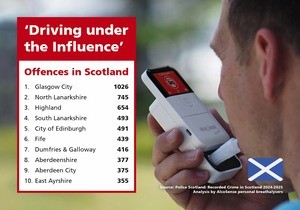
A total of 4,427 Scottish motorists were taken to court last year for ‘driving under the influence’ (DUI) according to figures published in today’s Criminal Proceedings in Scotland report.
Although this represents a decrease on the previous year, prosecutions are still up 15% compared with a decade ago - highlighting a persistent core of motorists who continue to risk lives by driving after consuming alcohol.
The number of drivers convicted was 4,260 - giving Scotland a 96% conviction rate for DUI offences.
The figures are released as Police Scotland gets underway with its annual Christmas and Hogmanay drink and drug drive campaign, which runs until 2 January 2026. Drivers can expect an increase in roadside breath testing, with targeted patrols in known drink-drive hotspots such as Glasgow, North Lanarkshire, the Highlands, South Lanarkshire and Edinburgh.
Last Christmas, officers carried out 4,779 breath tests and 963 roadside drug wipes, resulting in over 1,300 offences detected - the highest activity levels seen in recent years.
In 2023, ten people were killed by a drink driver and 300 were injured, according to Transport Scotland. While a reduction on the previous year, the toll remains “unacceptably high”, says Hunter Abbott, Managing Director of personal breathalyser firm AlcoSense.
“It only takes one impaired driver to devastate families,” comments Abbott. “With Scotland’s lower drink drive limit, even small amounts of alcohol can put you over the legal threshold.”
“The only reliable way to know you’re safe and legal to drive is to self-test with a personal breathalyser. Particularly the morning after a night out, when alcohol can remain in your system for many hours.”
Abbott warns that December is the highest-risk month for both collisions and enforcement.
“Police Scotland ramp up roadside checks over Christmas and Hogmanay. If you’ve been drinking, your chances of being breathalysed are significantly higher than at other times of year.”
- ends –
9 December 2025
Sources:
Scottish Government: Criminal Proceedings in Scotland 2023–2024
Transport Scotland: Reported Road Casualties Scotland 2024
Police Scotland Festive Drink & Drug Driving Campaign Statistics
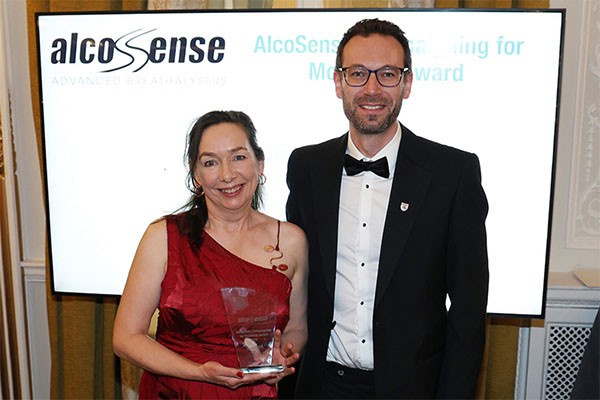
Louise Cole wins Guild of Motoring Writers Award, sponsored by AlcoSense
AlcoSense was delighted to support this year’s Guild of Motoring Writers Awards — the longest established and most prestigious honours in automotive media — which recognise excellence across motoring editorial by both Guild members and non-members.
We sponsored the Campaigning for Motoring category, which celebrates journalism that seeks to improve the lives of all road users, from road safety and electric vehicles to road maintenance and environmental issues.
Winner: Louise Cole
The judges selected Louise Cole for her long‑form book that helps fleet managers better support drivers’ wellbeing. Approved by specialist clinicians, charities and academics, her work stood out for its depth, practicality and potential to make a meaningful difference across the industry.
Presentation
Louise received her award at the Guild’s annual dinner, held at the Royal Automobile Club in Pall Mall, London, on 4 December, presented by AlcoSense Managing Director, Hunter Abbott.
Runners‑up
- Trinity Francis for three wide‑ranging features published in Roadway, UK Plant Operators and Commercial Motor
- Jack Carfrae for a series of features in Transport News
Why we sponsored Campaigning for Motoring
As a company dedicated to helping drivers make safer choices, AlcoSense believes high‑quality, evidence‑based journalism has a direct impact on motoring for everyone. We sponsored this award because campaigning writing:
- Improves road safety: Clear, accurate reporting raises awareness of risk factors — such as impairment and distraction — and helps inform better behaviours behind the wheel.
- Supports informed policy and infrastructure: Thoughtful analysis and investigations encourage decision‑makers to invest in safer roads, effective maintenance, and practical EV infrastructure.
- Champions driver wellbeing: Coverage that highlights mental health, fatigue, and workplace pressures empowers fleets and individual drivers to take proactive steps that reduce incidents.
- Accelerates positive change: Persistent, well‑researched campaigns help move good ideas from headlines to standards, guidance and everyday practice.
In short, great motoring journalism doesn’t just tell the story; it helps make the roads safer, cleaner and more efficient for all.
About the Guild of Motoring Writers
The Guild of Motoring Writers is a professional association representing automotive media across print, digital and broadcast. It supports high standards in reporting, provides networking and development opportunities for members, and celebrates outstanding work through its annual awards programme. The Guild’s community includes journalists, authors, photographers and content creators who cover everything from road safety and consumer issues to engineering, motorsport and sustainability.
About the Royal Automobile Club, Pall Mall
The Royal Automobile Club is one of the UK’s most historic motoring institutions and private members’ clubs, with its London clubhouse on Pall Mall renowned for hosting notable automotive events and celebrations. Its elegant rooms and heritage make it a fitting setting for recognising excellence in motoring journalism and the wider contribution of the media to safer, smarter mobility.
AlcoSense is proud to recognise work that makes a tangible difference to road users. Congratulations to Louise Cole, and well done to Trinity Francis and Jack Carfrae for their outstanding contributions.
» read more
Discover our commitment to safety, fair pricing, and quality all year round.
» read more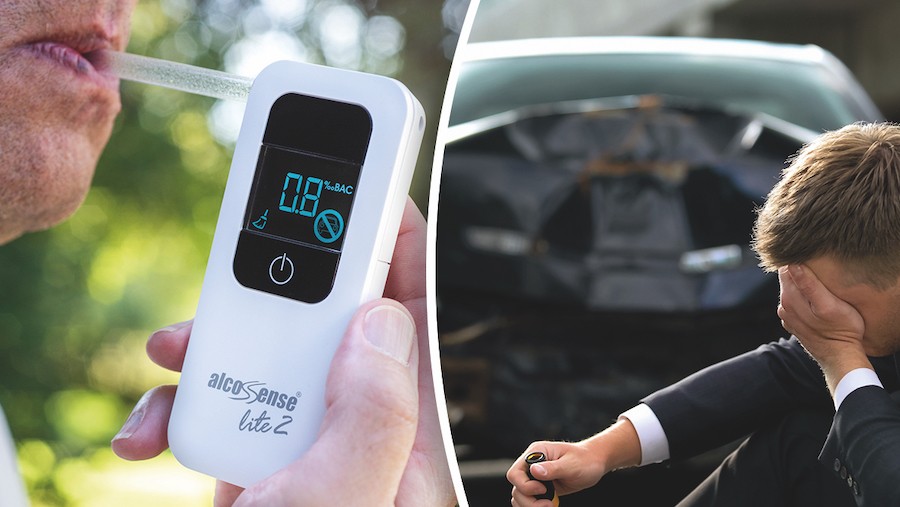
Drink-Drive Limit Reduction “Overdue but Welcome”
The government’s long-awaited proposal to lower the drink-drive limit in England and Wales is a welcome and overdue move, according to Hunter Abbott, Managing Director of AlcoSense Laboratories and member of the Parliamentary Advisory Council for Transport Safety (PACTS).
Labour plans to reduce the legal limit from 80mg of alcohol per 100ml of blood (0.80‰ BAC) to 50mg (0.50‰ BAC), bringing England and Wales into line with Scotland and much of Europe.
Writing on Road Safety GB Abbott says campaigners have warned for years that the English and Welsh limit is dangerously out of step with modern science and international best practice.
“At 80mg, a driver is around 13 times more likely to be involved in a fatal crash than someone sober. These are the ‘legal but lethal’ drivers we share our roads with,” he explained.
Even at the proposed new limit, drivers are still five times more likely to be involved in a fatal crash than when sober. Abbott argues that England and Wales should ultimately aim for a 20mg limit, as adopted by countries such as Sweden, Norway, Poland and - imminently - Spain.
“A 20mg threshold strikes the right balance,” he says. “It is below the point of intoxication, prevents impairment, and aligns with international best practice.”
Opponents often point to Scotland, claiming that its 2014 change had no measurable impact on casualties. But a 2024 AlcoSense survey, marking the tenth anniversary of the law, found that 79% of Scots believe it has made roads safer, 77% want England and Wales to follow suit and 40% report drinking less overall.
“The data shows that lowering the limit reshapes behaviour,” Abbott explains. “Fewer people drink when they know they will drive, and millions avoid risky decisions altogether.”
The latest government figures underline the urgency of reform. In 2023, 260 people were killed in drink-drive crashes, with 6,310 casualties in total. Progress has stalled: fatalities have hovered above 200 for nearly a decade.
Abbott insists the limit change must be paired with further measures, including more post-crash testing (currently just 37% of drivers are breathalysed, down from 51% a decade ago), random roadside checks (standard across Europe, but not in the UK) and stronger public education.
“At AlcoSense, we focus on helping people make safe decisions the ‘morning after’, when alcohol can remain in the system long after drinking. Our mission is to prevent dangerous guesswork, not to help people drink up to a limit,” adds Abbott.
“The UK once led the way on road safety with the first roadside breath test in 1967. We are now lagging behind. In 2025, there is no excuse for laws that allow impaired drivers on our roads. Reducing the limit will save lives - and that, surely, is reason enough.”
» read more
AlcoSense Triumphs in Parkers' 2025 Breathalyser Test
AlcoSense has once again proven its commitment to road safety and product excellence, securing top honours in Parkers' prestigious 2025 breathalyser test. With the UK poised to lower its drink-drive limit next year from 35 to 22 micrograms of alcohol per 100ml of breath (0.35 to 0.22 mg/L), accurate and reliable breathalysers are more essential than ever.
In a comprehensive review of the best breathalysers available in the UK, Parkers named the AlcoSense Pro Fuel Cell Breathalyser as its Editor’s Pick, praising its exceptional accuracy, advanced features, and user-friendly design. The Pro model impressed testers with its BlowCoach technology, temperature sensor, and country-specific configuration, making it the ideal tool for ensuring safe driving the morning after.
Also recognised were the AlcoSense Lite 2 and AlcoSense Excel, which earned accolades for their compact design, affordability, and professional-grade fuel cell sensors. These models offer peace of mind for casual and frequent users alike, reinforcing AlcoSense’s reputation for quality across its range.
Hunter Abbott, Managing Director of AlcoSense, commented:
"We’re proud to see our products recognised by Parkers. With the upcoming changes to UK drink-drive laws, it’s more important than ever for drivers to have access to accurate, easy-to-use breathalysers. Our mission is to help people make informed decisions and stay safe on the roads."
As the UK prepares for stricter limits, AlcoSense continues to lead the way in personal breathalyser technology—offering drivers the tools they need to stay safe, legal, and responsible.
Best-in-Test: AlcoSense breathalysers—trusted by experts, chosen by drivers.
Link to article: https://www.parkers.co.uk/car-advice/lifestyle-lei...